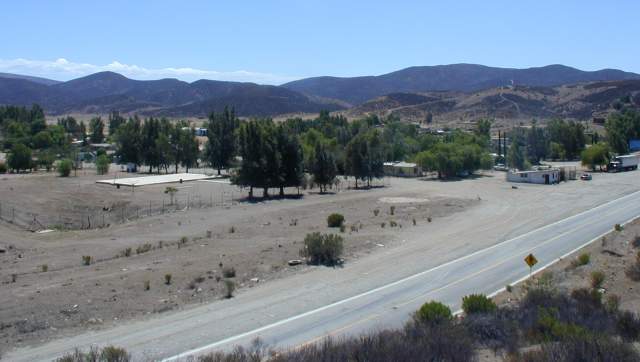
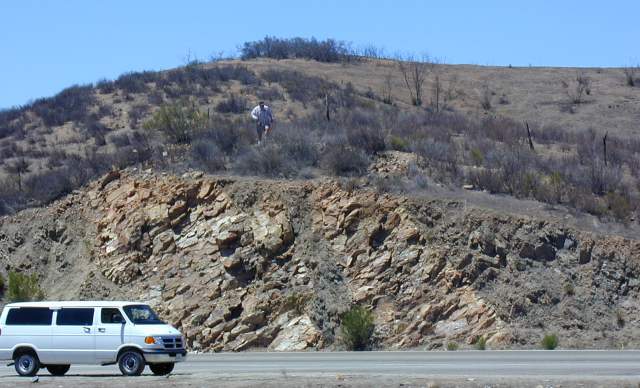
The San Marcos Dike SwarmAfter a short presentation on the aforementioned feature at UABC, the field trip stopped for lunch and a look at this feature that has been puzzling Dr. Dave Kimbrough of SDSU (and me - Phil Farquharson...) for some time.
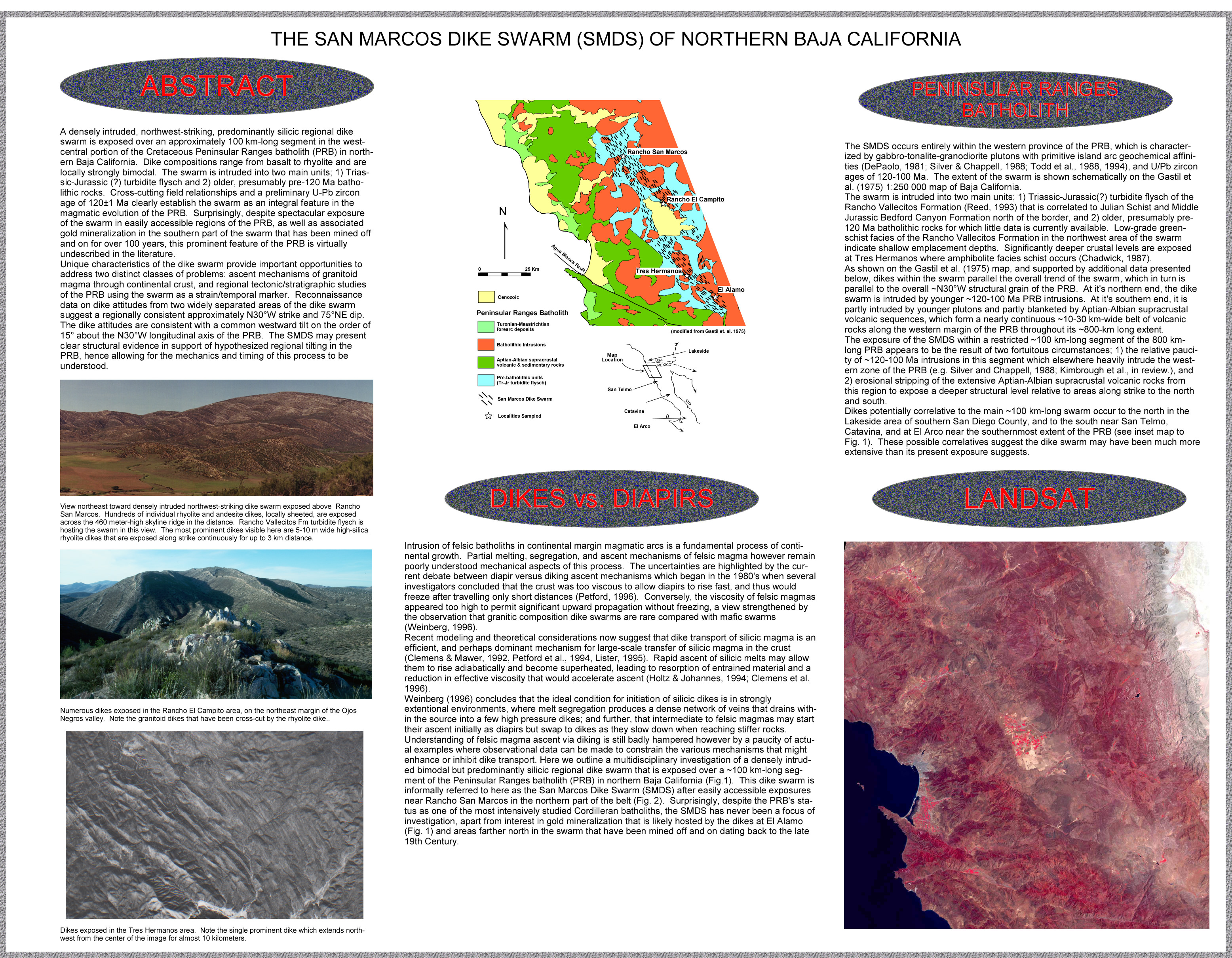
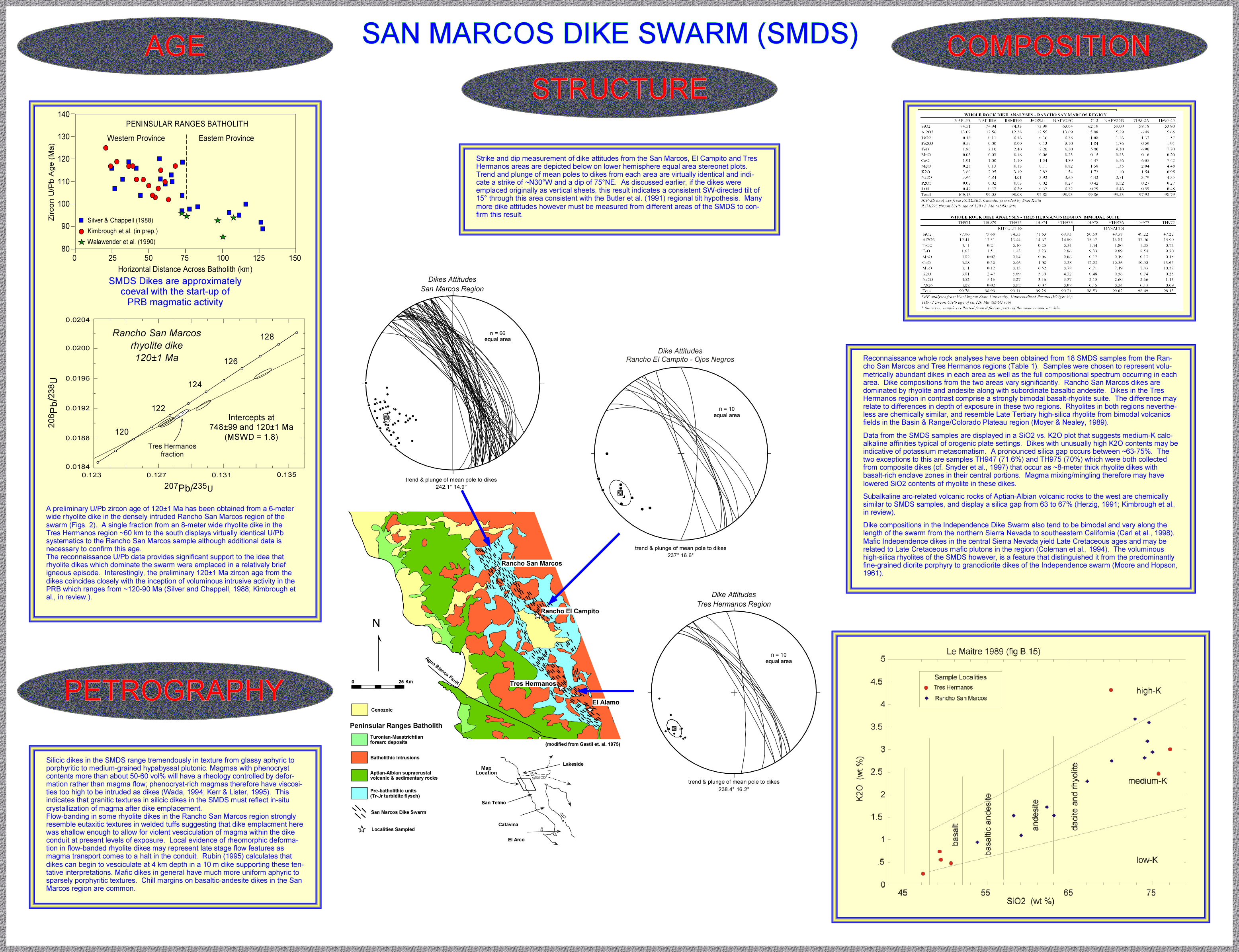
The San Marcos Dike Swarm (SMDS) is a dense, northwest-striking, predominantly silicic regional dike swarm that is exposed over an ~100 km-long segment in the west-central portion of the Cretaceous Peninsular Ranges batholith (PRB) in northern Baja California. Dike compositions range from basalt to rhyolite and are locally strongly bimodal. Cross-cutting field relationships and a preliminary U-Pb zircon age of 120±1 Ma clearly establish the swarm as an integral feature in the magmatic evolution of the PRB. Surprisingly, despite spectacular exposure of the swarm in easily accessible regions of the PRB, as well as associated gold mineralization in the southern part of the swarm that has been mined off and on for over 100 years, this prominent feature of the PRB is virtually undescribed in the literature.
Unique characteristics of the dike swarm provide important opportunities to address two distinct classes of problems: ascent mechanisms of granitoid magma through continental crust, and regional tectonic/stratigraphic studies of the PRB using the swarm as a strain/temporal marker. Reconnaissance data on dike attitudes from two widely separated areas of the dike swarm suggest a regionally consistent ~N30°W strike and ~75°NE dip. The dike attitudes are consistent with a common westward tilt of ~15° about the N30°W longitudinal axis of the PRB. The SMDS may present the first clear structural evidence in support of hypothesized regional tilting, hence allowing for the mechanics and timing of this process to be understood. Recent work has demonstrated that a combination of dike intrusion and rotation of domino-style fault blocks in the hanging wall of normal faults can accommodate extension in rifted margins and spreading centers.
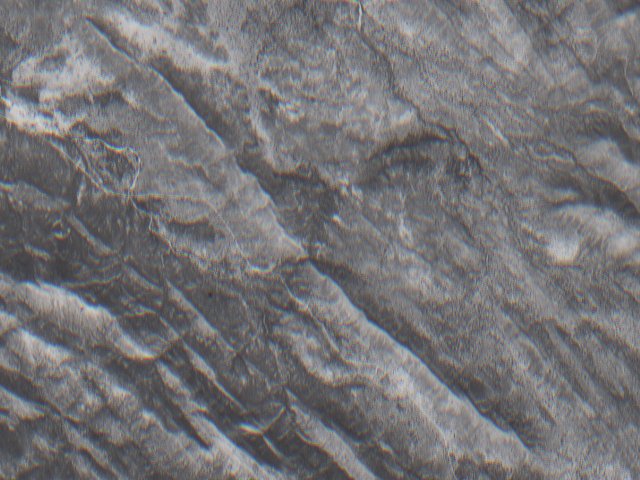
The image below is from an air photo of the Tres Hermanos region, south of Ojos Negros. It shows a 3-km.-long continuoua rhyolite dike. Additionally, it now appears that some of the dikes in the Ejido San Marcos area may have fed some of the Santiago Peak Volcanics extrusive rocks found to the immediate west and northwest of the Valle Guadalupe.
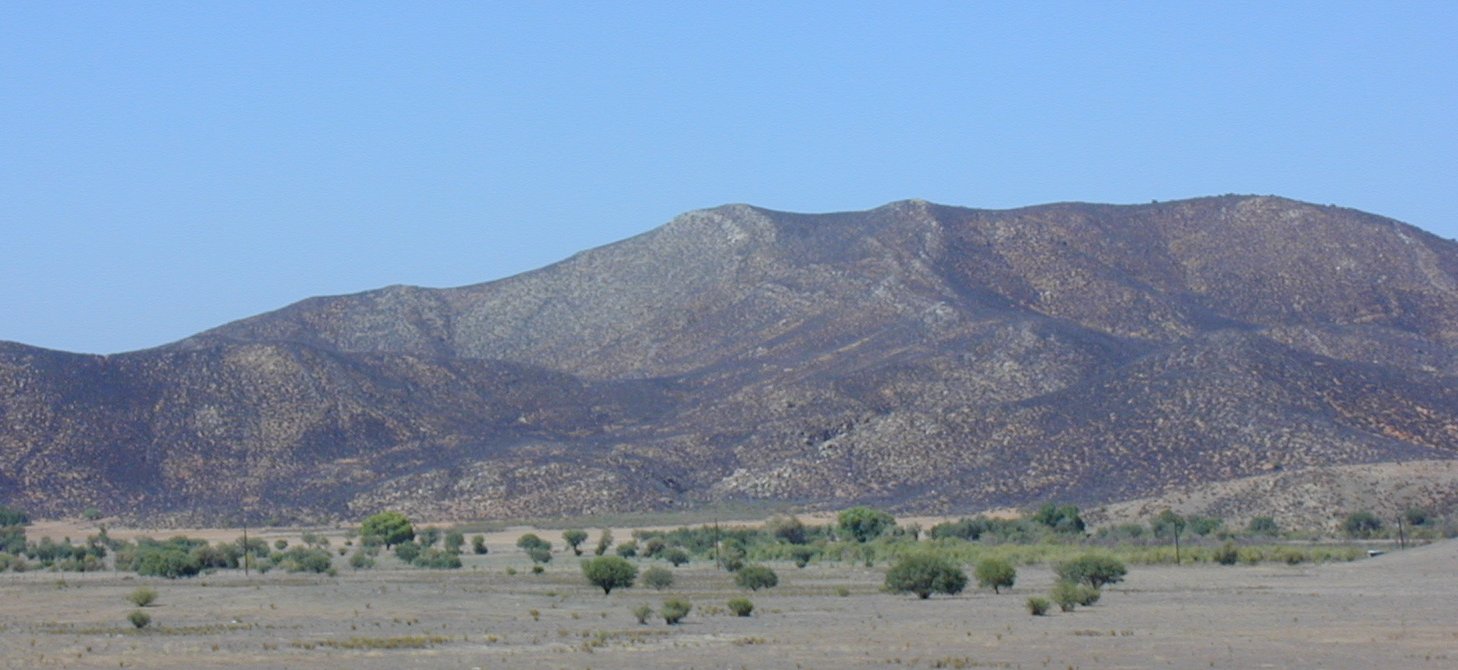
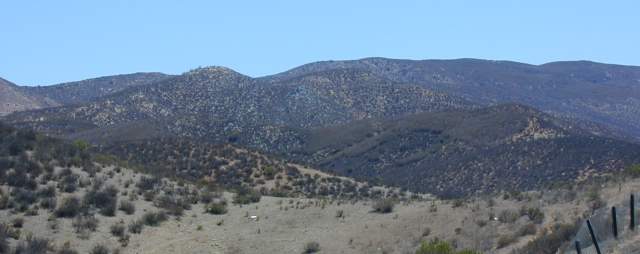
Another interesting geological feature observed at his lunch stop was the Ordovician olistolith described by Carl Lothringer in GSA Special Paper 279 (1993). Here's a picture of same (bluish rocks in center of image), then the abstract:
At Rancho San Marcos, halfway between Tecate and Ensenada in northwestern Baja California, a 1 km by 5 km group of giant olistoliths of Early Ordovician age occurs within phylite and metasandstone of Mesozoic(?) age. This group of giant olistoliths is underlain by a melange of olistolith-derived granule to boulder-size fragments in a foliated, phyllitic matrix. Granitic rocks and andesite/dacite dikes of the Cretaceous Peninsular Ranges arc and batholith intrude both autochthonous and aflochthonous rocks. The olistoliths of Ordovician rock are resistant, moderately to well-sorted, blue-gray quartzite; brown, gray, and black, commonly argillaceous, bedded chert; medium to dark gray, finely to coarsely recrystallized, carbonate rock; minor amounts of brown to gray-green metaargillite; and clast-supported cobble conglomerate. North Atlantic and Mideontinent province conodonts from the carbonate rock indicate a medial Arenigian (Early Ordovician) age. Both the Ordovician (allochthonous) and Mesozoic (autochthonous) rocks have undergone low greenschist grade regional metamorphism of Cretaceous age. The quartzite has been openly folded, but argillaceous units are pervasively foliated and isoclinafly folded with strikes N30 to N70°W, and dips to the northeast. Field relationships suggest that the melange is sedimentary, not tectonic, in origin. Emplacement occurred at a time of tectonic unrest during which debris was shed westward off an unstable continental margin into flysch basins. The allochthonous rocks of Rancho San Marcos appear similar in age and lithology to portions of the eugeoclinal Valmy Formation of north-central Nevada. If these strata are correlative, palinspastic reconstruction appears to require large-scale left-lateral displacement. Proposed sinistral displacement on the medial Jurassic Mojave-Sonora megashear, plus northward translation on the San Andreas fault system in the Neogene, would place Valmy-equivatent rocks at roughly the same latitude as San Marcos. Phil Farquharson's Thesis Is Complete, and On-line!30 July 2004, almost two years after this field trip was completed, my thesis on the SMDS was accepted by the SDSU Grad Division. You may see it online here (opens a new browser window). Posters...
|
 Summary |
|---|