|
Stop 9. Sacatone Springs roof pendant |
|---|
|
Drive east on old Hwy 80 about two miles past Boulevard to the McCain Valley road. Turn left (north) and proceed about two miles to the first dirt road leading right (east). Follow dirt road approximately two miles to end.
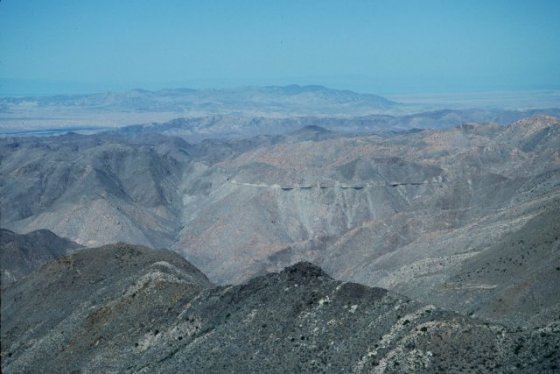
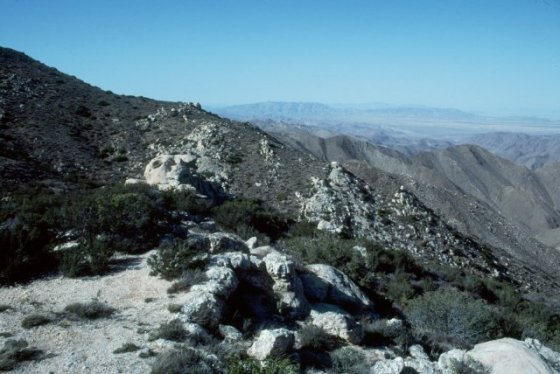
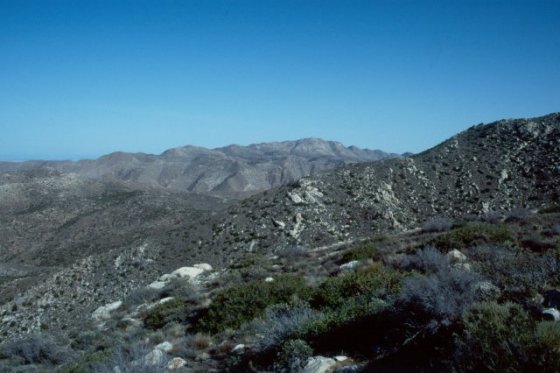
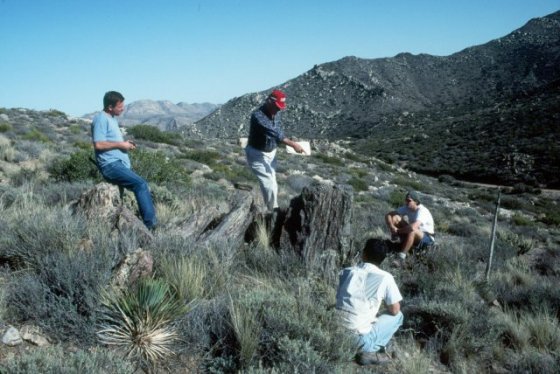
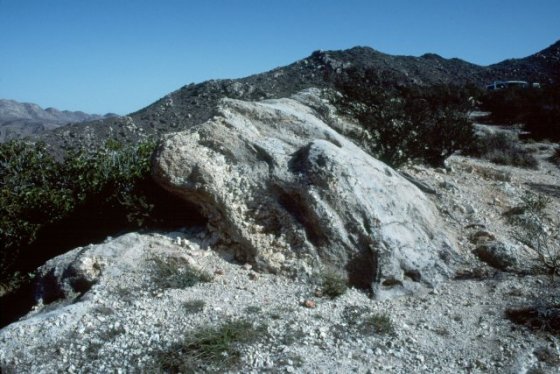
At this stop, the view to the north shows the contact between the metasedimentary screen and the La Posta pluton. The nature of the screen outside the Sacatone Springs area is not well known. It contains metasedimentary and meta-igneous rocks as well as small hornblende-rich dioritic pods. Dark, relatively mafic-rich tonalites exposed around the overlook area are interpreted to be part of the La Posta melt that quenched against the screen.
The metasedimentary package consists of locally migmatitic pelitic and psammitic schists and gneisses with discontinuous amphibolite pods. The schists and gneisses commonly contain sillimanite, biotite, white mica, feldspar, and quartz. Protoliths probably were quartz-rich sandstones (cherts?), mudstones, and marls along with lesser amounts of mafic to intermediate composition volcanic materials. Two sets of structures are evident in the roof pendant. The first set includes tight to isoclinal inclined F1 folds. Their axial surfaces are refolded by F2 folds but strike generally northeastward and are subparallel to the contact with the La Posta pluton. Hingelines of F1 folds are steeply plunging. F2 folds are tight to open and upright. Their hingelines plunge down the dip of the prominent layering in the roof pendant. F1 folds may have formed during a pre-La Posta deformational event. In contrast, some La Posta-related pegmatitic dikes are folded by the F1 event. This relationship and the geometry of the F2 folds suggest that the latter formed as a result of the emplacement of the La Posta pluton.
Pegmatitic dikes are common. To the south is Tule Mt. with numerous dikes as well as small bodies of garnet-two mica granitoids similar to the one that we will visit at Stop 17. The small open pits north of the viewpoint are in the Pack Rat claim from which large (1-2 ft) doubly terminated smoky quartz crystals and gemmy 1-cm spessartine garnets have been extracted. Further north over the next ridge is the Bebe Hole from which nearly $500,000 in gem kunzite was taken in the mid-1980s. Beryl has been found in many of the dikes in this system. Most were frozen into the rock but several larger gemmy matrix specimens have recently been recovered along with apatite and cassiterite. Apatites extracted from the pocket zone of the pegmatite yielded a present-day Sr ratio of 0.71547 with 0.68 ppm Rb. The age of the dike is not known but similar pegmatites across the canyon to the east are intruded by 89 Ma granite. The classic southern California pegmatites to the north near Pala, Mesa Grande, and Rincon have yielded Ar-Ar ages between 99 and 96 Ma (Foord and others, this volume).
The limited field and isotopic data suggest that these dikes are the result of anatexis of a metasedimentary package similar to the one exposed in this screen and that they are genetically related to the larger garnet-two-mica (S-type) granitoids within the screen (Stop 17). The heat source for this event was likely due to the rise of the large La Posta-type plutons into shallow (2.5-3.0 Kb) crustal environments. One additional interesting aspect of this screen is its relationship to the K-Ar ages reported by Krummenacher and others (1975). Much has been made of the apparent eastward decrease in these cooling ages, especially the wider gap between the cooling and emplacement ages in the eastern PRB. Most, if not all, of the youngest K-Ar ages fall east of this screen which continues southward for an additional 50 km or so. Thus, the structural significance of the screen has yet to be determined. |